
New AFib treatment helped Bob Griffin return to his active lifestyle
Bob Griffin has always been an active person. The 76-year-old retired dentist has been rock climbing for more than 50 years and is an avid skier and mountain biker, as well as a regular in the gym. After finishing up a weight-training routine at the Logan Health Medical Fitness Center in June of 2025, Bob, who routinely monitors his heart rate during workouts, noticed on his Apple Watch that it was not dropping the way it normally would following physical activity. He decided to run the electrocardiogram (ECG) function on his watch, which produced an unexpected result: “Your heart has shown signs of an irregular rhythm suggestive of atrial fibrillation,” the alert read.
Atrial fibrillation, or AFib, is a common heart rhythm disorder that causes an irregular heartbeat and increases the risk of blood clots and stroke if left untreated.
 Bob happened to be working out with his son, a neurosurgical physician assistant, who assessed the situation and directed him to go straight to the emergency department across the street. Upon arrival, the emergency team, in collaboration with the on-call cardiologist, confirmed he was in AFib and administered medication to bring his heart rhythm back to normal. He was monitored for a time and eventually cleared and released with a medication plan and an appointment with the Logan Health Heart & Vascular clinic.
Once there, Bob was connected with a general cardiologist to coordinate his care and the clinic’s electrophysiology team, led by Dr. Matt Brunson. Electrophysiology is a specialized area of cardiology focused on diagnosing and treating heart rhythm disorders like AFib. Bob was diagnosed with paroxysmal atrial fibrillation, a version that occurs intermittently rather than continuously. Dr. Brunson spoke with him about treatment options. For patients with AFib, there are typically two options for treatment: Medication or a minimally invasive cardiac ablation procedure.
“Both are legitimate options for most patients,” said Dr. Brunson. “About half start with anti-arrhythmic medication. The other half prefer to move directly to ablation to treat the underlying electrical problem.”
Medications are an effective way to treat AFib, but some patients can develop negative side effects. That was the case for Bob. “My heart rate had lowered quite a bit to the point where I had to ease off the medication a bit,” he recalled. “I was eager to pursue other treatments, and it was clear the ablation was the best option for me.”
Dr. Brunson informed Bob of a newer form of ablation for AFib that Logan Health had adopted just months earlier, known as pulsed field ablation, or PFA. Ablation works by disrupting the abnormal electrical signals in the heart that cause AFib, helping to restore a normal rhythm. While traditional ablation techniques rely on either extreme heat or cold to correct those signals, PFA uses targeted electrical pulses to treat the problematic heart tissue. Today, all AFib ablation procedures at Logan Health are performed using this pulsed field approach because it carries less risk of damaging nearby structures like the esophagus and nerves, which lowers the risk of complications and allows for faster recovery and overall better patient outcomes.
The technology was introduced nationally in 2024 following FDA approval, and Logan Health moved quickly to bring the procedure to Kalispell. Recognizing both the advancement in patient care and the growing need for specialized heart rhythm treatment in northwest Montana, Dr. Brunson and the electrophysiology team worked with Logan Health administrators to make PFA available locally.
The first PFA procedure at Logan Health was performed in April 2025. By the time Bob met with Dr. Brunson for his initial visit, the team had already completed dozens of cases using the pulsed field method, gaining early experience with the technology and seeing overwhelmingly positive results. After discussing the option with his care team and doing his own research, Bob felt confident that PFA was the right treatment choice for his condition
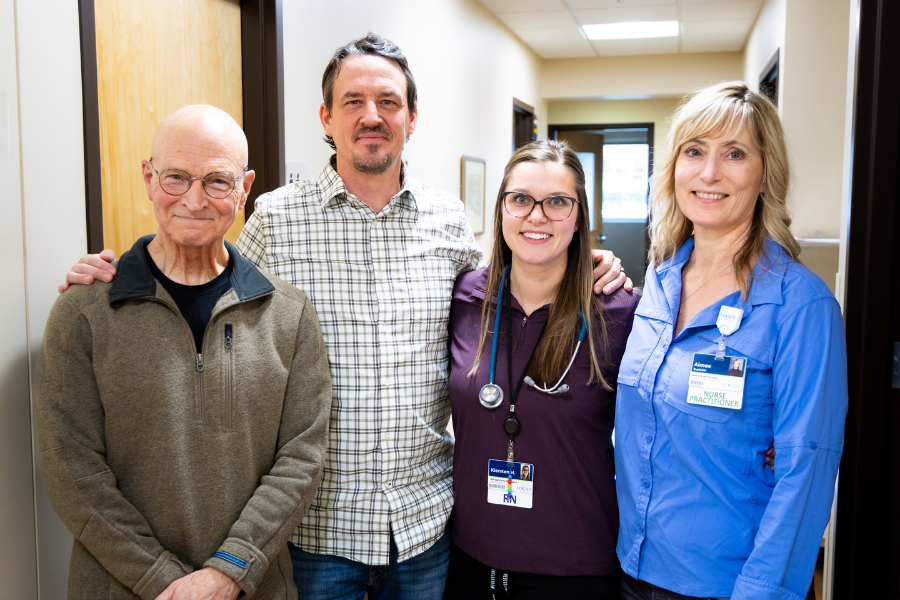
Bob Griffin with the Electrophysiology Team at Logan Health Heart and Vascular. (L-R) Bob Griffin, Dr. Matt Brunson, Kiersten Hubbard, Aimée Zupicich
Bob’s procedure was scheduled later in the year, following the completion of another necessary medical procedure. By the time he underwent his ablation in November, more than 100 PFA procedures had been completed by Dr. Brunson and his team, a milestone that reflected both the demand for AFib care in the Flathead Valley and the success of the new technology.
“It was reassuring to know they had already done that many successful procedures,” Bob said, noting that he was the 102nd PFA case completed in Kalispell. “When you’re having a procedure like that, it helps to know your provider has a lot of experience.”
Bob described the entire process — from initial consultations through the day of treatment — as seamless. The procedure itself took less than an hour, with his total time at the hospital amounting to roughly five hours, including preparation and recovery. He was able to go home that same day.
As Bob had hoped, the recovery from the procedure was minimal. He was advised to avoid strenuous exercise for about a week, allowing his body time to heal. Beyond that brief restriction, he experienced no complications and was able to quickly return to the active lifestyle he has enjoyed for decades.
Stories like Bob’s show a growing demand for advanced heart care in northwest Montana. “Seeing how quickly pulsed field ablation has taken off shows how much of a need there is in this community,” said Dr. Brunson. “For many patients, it has made a real difference in their lives and offering it here in Kalispell helps us meet the growing demand for advanced, low-risk treatment options. Our team is looking forward to connecting more patients to the right treatment option and expanding access to this procedure throughout northwest Montana.”
For more information about heart services at Logan Health, visit logan.org/heart.