
When Paul Levanen first heard about art therapy at Logan Health, he was skeptical. He was already navigating treatment for multiple myeloma, and the idea of returning to the medical campus for a class, especially one centered on art, felt uncomfortable.
Paul recalled telling his care team, “I’m no kind of artist. I don’t know nothing about artists or drawings.” Still, with encouragement from Logan Health Naturopathic Oncologist Dr. Lynn Troy, Paul decided to give art therapy a try. That choice changed far more than he expected.
“I was kind of sheepish when I came in,” he said of his first session. Sitting among six to eight other patients, Paul wasn’t sure what to say or do. However, as introductions began and stories were shared, something shifted. “Some had the same thing I did, so we could compare notes… I wasn’t feeling like I’m the only person with any type of cancer,” he added. Paul had found comfort in connecting with others on a similar journey.
Art therapy involves the creation of art to facilitate conversations. The materials used help direct the objectives for each person. Led by registered art therapists, group sessions help patients process emotions, reduce stress and connect with others. Each session offers simple prompts and a wide range of materials, allowing patients to explore what they’re feeling at their own pace.
Logan Health Board-Certified Art Therapist Jason Heisey, LCPC, ART-BC, facilitated Paul’s group. He focuses on creating a safe, judgment-free space. “There’s no right or wrong outcome,” he often reminds participants. The art, he explained, is simply a starting point or a catalyst for reflection and conversation.
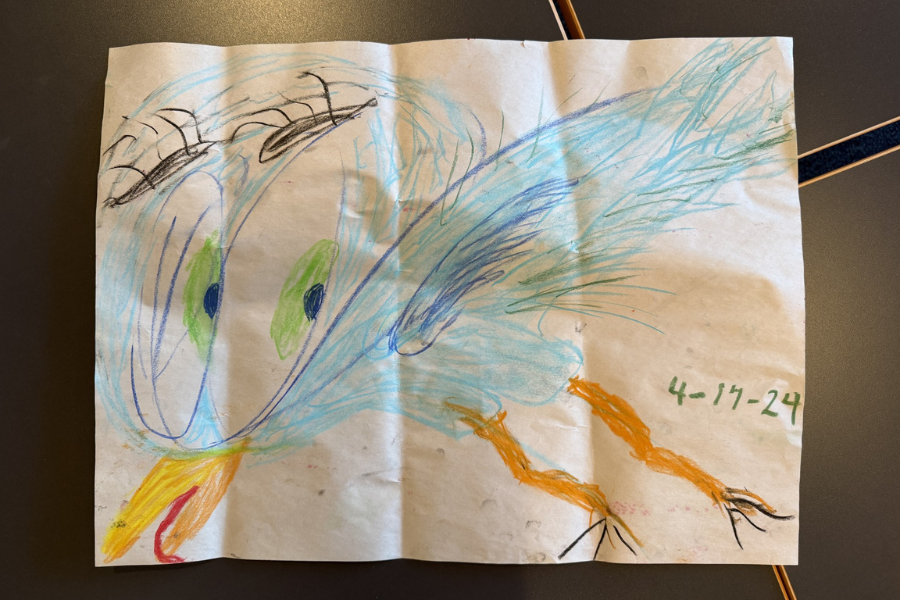 Paul felt that catalyst immediately. In one session, he was asked to draw a place where he felt completely comfortable. In another, he closed his eyes and scribbled, later turning the marks into a bird.
“I just kind of felt like, OK, I can fly away,” he said. Over time, the projects became deeply personal, including a small box filled with symbols of faith, family and love. “I’ve held on to these because they’re special,” Paul shared. “They brought me to a better frame of mind.”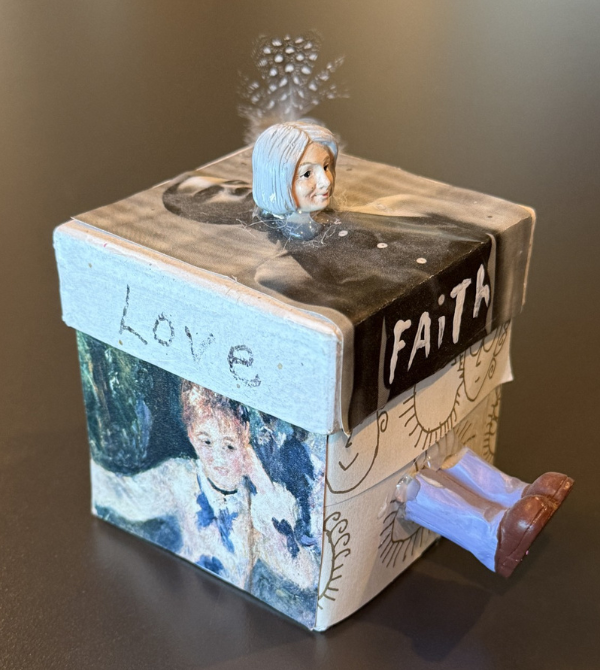
What surprised him most was how quickly the group became a source of support through his cancer journey. “By the end, it was okay to talk about it,” he recalled. “It was a huge opening.” The sessions helped him feel grounded, connected and understood. “I couldn’t wait to get back,” he added. “It kind of formed a family.”
Now, two years later, Paul still looks at his artwork and reflects on his time in art therapy. For patients who feel unsure about art therapy, he offers simple advice, “It’s understandable to feel apprehensive, but after a couple of sessions, you think, ‘This is what I need, actually.’”
His message is clear. Healing doesn’t always come from medicine alone. Sometimes, it starts with a piece of chalk, an open table and the freedom to simply be yourself.