
At 14 years old, Piper was used to being active and independent. She played volleyball, wrestled and competed in track and field. Sitting still was never really part of the plan.
Then, in a matter of seconds, everything changed.
While at her family’s lake house, Piper was handling nail polish remover when it accidentally ignited. Flames spread across her clothing and body. She ran outside, where her mother immediately yelled, “Stop, drop and roll,” raced after her and began putting out the flames.
After getting Piper into the lake, her mother assessed her injuries. The skin on Piper’s hands and fingers was coming off, and her abdomen and upper thighs were badly burned. She knew the injuries were serious.
“I knew I had to remain calm in order to keep Piper calm until we could get to the hospital,” she said. “I honestly probably didn’t process everything until after they got her into surgery that night.”
Twenty percent of Piper’s body had been burned, including her hands, arm, stomach and thighs. Some of the burns were third-degree.
What followed was intense pain, surgery, dressings and, eventually, skin grafting. But for Piper, one of the hardest parts came after she returned home.
“I want to be really independent,” Piper said. “I like doing things for myself.”
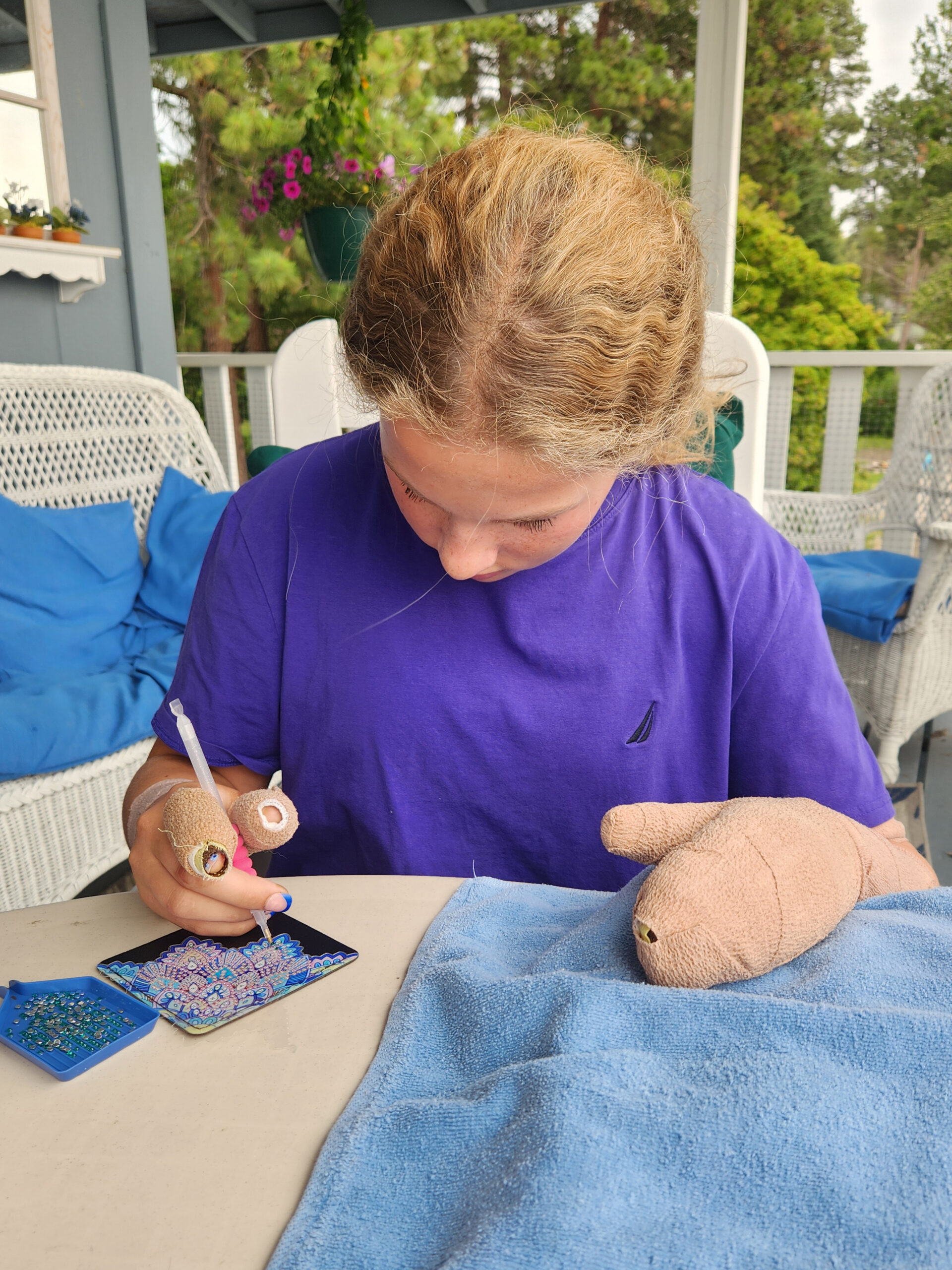
Suddenly, even simple tasks were difficult. One hand was placed in a protective mitt, while several fingers on the other were badly burned. Her mother helped with her hair, dressings and everyday needs.
Still, Piper looked for ways to regain her independence. When eating became difficult, she figured out how to grip a fork with the fingers she could use. When she needed a drink, she found a way to hold the cup herself.
Those small victories were signs of something her doctors and family would see throughout her recovery: determination.
“Piper is a special girl,” said Dr. Rona Norelius, one of Logan Health’s pediatric burn surgeons. “She always maintained a good attitude. She was able to laugh about the inconveniences.”
Just as important, Dr. Norelius said, Piper followed the medical guidance she was given through each stage of healing. Burn recovery requires a careful balance. Movement may initially need to be limited, followed by stretching, strengthening and rehabilitation to restore function.
Piper embraced each step.
Her recovery also benefited from something her family hadn’t expected: the ability to receive her burn care close to home.
 Dr. Norelius and Dr. Daniel Weaver, Logan Health’s two pediatric burn surgeons, were able to provide Piper’s specialized care in Kalispell, including skin grafting. Logan Health’s pediatric surgery team is the only medical team in Montana providing this level of pediatric burn care, with the ability to support children through the immediate injury and the long-term phases of recovery and healing.
For Piper’s family, that meant they didn’t have to leave Montana for treatment.
“To be able to drive 30 minutes from our home and only spend two nights in the hospital was a blessing,” Piper’s mother said.
Traveling out of state would have meant hotels, meals and significantly more time away from home and work. Both of Piper’s parents are self-employed, and her older brother was starting football at the same time. Staying close also meant that while Piper couldn’t yet participate in volleyball, she could still attend practices and remain connected to her teammates.
Her frequent follow-up care was close, too. At first, Piper returned nearly every week. As she improved, visits became monthly, then every few months and eventually a year apart. Her care team monitored her scars and mobility and worked with her to regain movement in her hands, legs and abdomen.
Her progress surprised even her family.
Piper’s mother initially wondered whether her daughter might miss much of her freshman sports season. Instead, Piper was fully released to play volleyball just three weeks after her skin grafts.
Eventually, she returned to volleyball, wrestling, track and the active life she loved. Some effects remain. Her hands can still become painful from friction or gripping heavy objects, and some areas have little sensation.
The physical recovery, however, was only part of Piper’s journey.
For about six months, she was self-conscious about her scars and the donor site on her leg. She often covered them and initially didn’t want people to know what had happened.
Then something began to change.
During wrestling season, Piper started talking about her scars when people asked. Her mother believes those conversations helped Piper process what she had experienced. Today, the scars she once tried to hide have become something she is proud of.
Dr. Norelius and Dr. Weaver also recommended that Piper consider attending Camp Eyabsut, a burn camp in the Seattle area for young burn survivors.
Piper decided to go because she didn’t want to feel “weird” about what had happened.
“There’s other people like this,” she realized. “I don’t have to be insecure about this.”
Camp brought friendships, confidence and eventually an opportunity for Piper to help others. After only two years, she was recognized for her leadership and invited to travel to Washington, D.C., to represent the camp and raise awareness for burn survivors.
“I’m not alone,” Piper said. “Nobody’s alone.”
Her doctors see that willingness to share her experience as another milestone in her recovery.
“I love that Piper has embraced her experience as something to be shared to raise awareness,” Dr. Norelius said.
For someone recovering from a burn, injury or corrective surgery, physical changes can sometimes feel as difficult as the injury itself. Scars can affect how someone sees their body and how comfortable they feel when others notice something different.
Piper understands. She also knows those changes don’t have to determine what comes next.
“Be yourself. People are going to love you for who you are,” Piper said. “There’s absolutely nothing you should be insecure about with your burns.”
And she offers one more piece of advice:
“It doesn’t define you. You can make something out of it or you can dwell on it. So make something out of it.”
Two years after an accident that temporarily took away much of her independence, Piper is back to being an athlete, a student and a teenager looking toward her future.
Only now, she is also an advocate, turning one of the most difficult experiences of her life into an opportunity to make someone else’s recovery a little less lonely.