
At 65, Margaret felt like she had the world by the tail.
Horses had shaped much of her life. Before moving to Montana in 2000, she ran a riding school in Ohio with 15 horses and about 60 students. In northwest Montana, she continued teaching riders throughout the Flathead Valley.
Margaret was active, independent and deeply rooted in her community and faith.
Then she found a lump.
Cancer didn’t run in her family. Illness wasn’t something she expected. Suddenly, the woman who had spent decades confidently guiding horses and riders faced something she couldn’t control.
“I was astonished,” she recalled. “It was shocking. Just shocking.”
What happened next moved quickly. Margaret was referred for breast cancer care, underwent genetic testing and was connected with oncology. By the end of July, little more than a month after her June diagnosis, she had begun chemotherapy.
The diagnosis was frightening: an aggressive form of breast cancer. Margaret began doing what she naturally does when faced with a problem—asking questions and learning everything she could.
But she didn’t face it alone.
“There was a team,” Margaret said. “So many people showed up and said, ‘Okay, now this. Okay, now this. Okay, now this.’ Because I didn’t know anything about cancer.”
That team extended beyond the hospital. Her husband, family, friends and church community rallied around her. At the center was a faith that helped Margaret confront even the possibility that treatment might not work.
Choosing Care Close to Home
Margaret knew people who responded to cancer diagnoses by traveling to major medical centers in Texas, Seattle and elsewhere. Friends and family outside Montana questioned whether sophisticated cancer care was available in a rural state.
But people Margaret knew who had sought treatment elsewhere came home with an important message.
“The care here is as good, if not better,” she said. “I took that to heart.”
She chose Logan Health.
Her treatment included chemotherapy, immunotherapy, oral medication and a double mastectomy. Her cancer proved difficult to treat, and chemotherapy didn’t produce the response initially hoped for. During treatment, she also became seriously ill with COVID-19 and required hospitalization.
Margaret studied survival statistics and confronted the possibility that she might die. She made end-of-life plans and even wrote her own obituary.
“I wanted the last word,” she joked.
Behind the humor was a deeply held conviction.
“I purposely chose to put my faith in God and say I’ve been put here for reasons,” Margaret said.
Her faith didn’t remove the fear or make treatment easy. It gave her a foundation from which to face both.
Her care team provided another source of strength. Margaret remembers the infusion nurses, warm blankets, hot soup and small acts of kindness during hours-long treatments.
“Nobody’s writing me off here,” she remembers thinking. “So I guess I can’t write myself off.”
Someone in Her Corner
Early in treatment, Margaret was offered something she might not have expected to find close to home: participation in a clinical trial.
She said yes.
That decision brought Helen into her life.
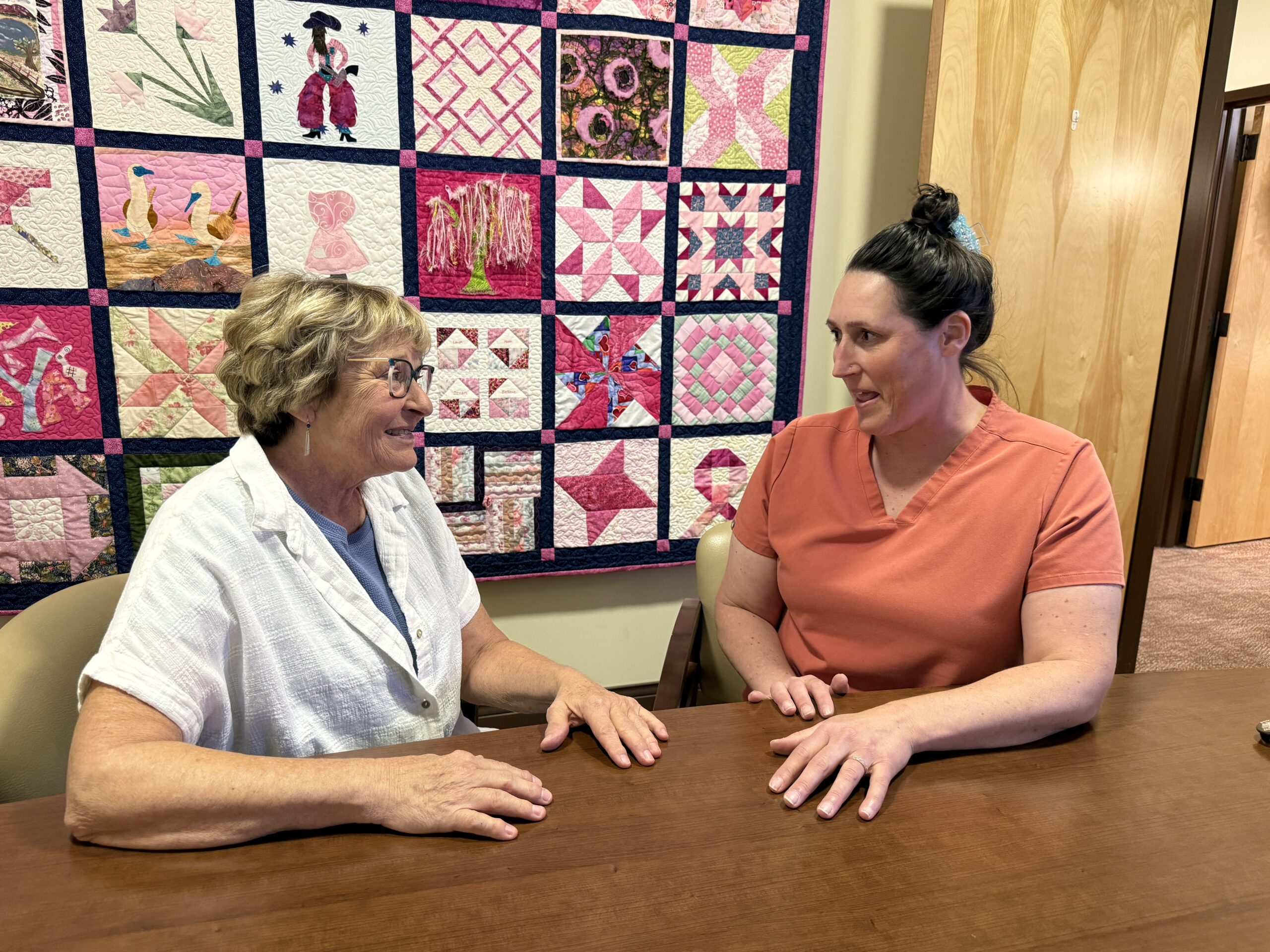 Helen is a research coordinator for Logan Health’s hematology and oncology clinic. Her job is to understand the research protocol, track Margaret’s progress and help her care team navigate the trial. But their relationship became more personal.
With her own experience as a cancer survivor and patient advocate, Helen understood that sometimes a patient needs someone reminding her that her voice matters.
“I want to always be in the patient’s corner,” Helen said, “to allow them to feel the space to really stand up for themselves and to advocate for themselves.”
Margaret remembers Helen repeatedly encouraging her to ask questions.
“She was always in the background saying, ‘It’s about you. It’s about you,'” Margaret said.
Over two years, their relationship grew beyond appointments and protocols. They talked about life and shared pictures of their dogs. Margaret has even spotted Helen walking down the street and stopped the car to say hello.
Helen still tracks symptoms and follows the research protocol, but she believes cancer care requires something beyond the science.
“There’s also a humanness to the work,” Helen said.
Staying the Course
For Margaret, participating in the clinical trial gave the difficulty of treatment greater purpose. When treatment became grueling and others questioned whether she should continue conventional medicine, the trial helped her remain committed to the path she had chosen. The information gathered from her experience might also help someone else someday.
Margaret describes a convergence of support that carried her through cancer: skilled medical professionals, Helen’s encouragement, family and friends, her community and prayer.
“My team saved my life. Prayers, family and friends saved my life for a reason,” she said.
Surviving created another question: What should she do with the life she had been given back?
Unpacking the Bags
Today, Margaret is approaching an important milestone; it’s been nearly two and a half years since her diagnosis.
Her cancer had not spread to her lymph nodes, and treatment and surgery worked. But survivorship hasn’t meant returning to the woman she was before cancer.
“I have shape-shifted,” she said.
She still deals with the effects of treatment. She cannot spend long days riding horses as she once did. Her last horse is gone, closing a chapter that defined much of her life.
“I’ve had to recreate who I am and what my life is about now,” she said. “We’ll see what God has in store for this chapter.”
For another Montana woman beginning a cancer journey, Margaret’s advice comes from everything she learned along the way: Ask questions. Be your own advocate. Search and research, then commit to the process you’ve chosen. Treatment can be grueling, and there may be detractors along the way.
For Margaret, the clinical trial encouraged her to stay the course because the data collected could conceivably help others. Cancer reinforced something she already believed: Our purpose here is to help others along the road.
And for women wondering whether a breast cancer diagnosis in rural Montana means leaving home to find advanced care, Margaret’s experience offers reassurance.
“Boy, you’re in a good place here,” she said. “You’ve got good help.”
Margaret stayed in Montana. Here, she found multidisciplinary cancer treatment, clinical research and medical professionals who paired expertise with compassion, all within the community where she had built her life.
Now, after preparing herself for the possibility that there might not be another chapter to life, Margaret faces the unexpected task of living it.
“My bags were packed,” she said.
Now she is unpacking them, surrounded by faith, friendship and gratitude, and waiting to see where the road leads next.
Article as seen at 406Woman.com